

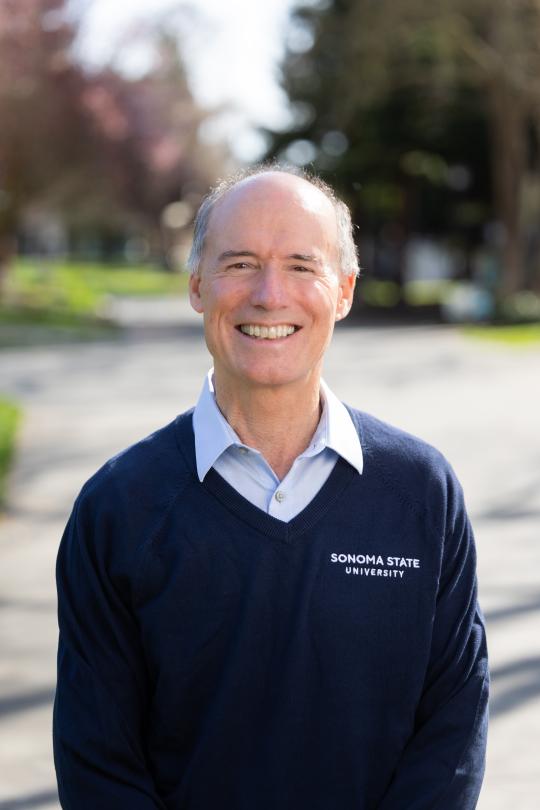
Robert Train
Tile and Department:
Professor of Spanish
Ethnic Studies and Languages
How did you end up going into your current role or field and what do you enjoy most about the work you do?
I became an educator-researcher to contribute to the public education and the well-being of our Latine students and families in California. I was working in vineyards in Napa and Sonoma counties, when the Immigration Reform and Control Act (IRCA) of 1986 became law. I saw many hardworking men and women with whom I worked—all immigrants from Mexico—find their much deserved path to permanent residency and citizenship. In that historic moment, I wanted to be part of making the multilingual and multiracial--but also deeply racist-- California where I was born into a more just and more welcoming place for immigrant families. I decided to go to college and become a teacher because I knew that the children of my co-workers and millions of others would need caring bilingual teachers who would understand and respect them and their diverse intergenerational experiences.
What do you enjoy most about being part of the Sonoma State community?
I appreciate the small scale of human interactions. It is a privilege to get to know so many of my students and my colleagues (staff, professors and administrators) in ways that would be impossible at a larger institution. Despite institutional silos and lack of resources, I value the collaborations and connections that are so much a part of what I enjoy about being at SSU.
What do you find most fulfilling about working in higher education?
I love teaching, researching and mentoring. After being a high-school teacher, I became a university professor to connect my work as an educator with my interdisciplinary research on critical experience-based heritage language education and the complex historicity and coloniality of Spanish language education in California. My education-centered research allows me to participate in regional, national and international communities through my publications, peer-review and presentations. I am also very grateful to mentor rising scholars among my students and my junior faculty colleagues at SSU and at other universities.
In what ways does your work make an impact on students, the campus or the broader campus community?
I have served students, families and communities with compassion and commitment to students from all backgrounds in Spanish courses, First Year programs, Spanish/bilingual language teacher education and CSU-International Programs. As a Latine-focused educator, I feel particularly fortunate to help each year in building a sense of community and belonging with our Latine students, colleagues, and their allies through my work in Spanish classes designed to intentionally serve our students as future bilingual professionals. Our struggle to build and maintain community involves my participation in Alianza for Equity, the DREAM Center, Nu Alpha Kappa, the Hispanic Serving Institution Advisory Council and other groups.