

Lauren Morimoto
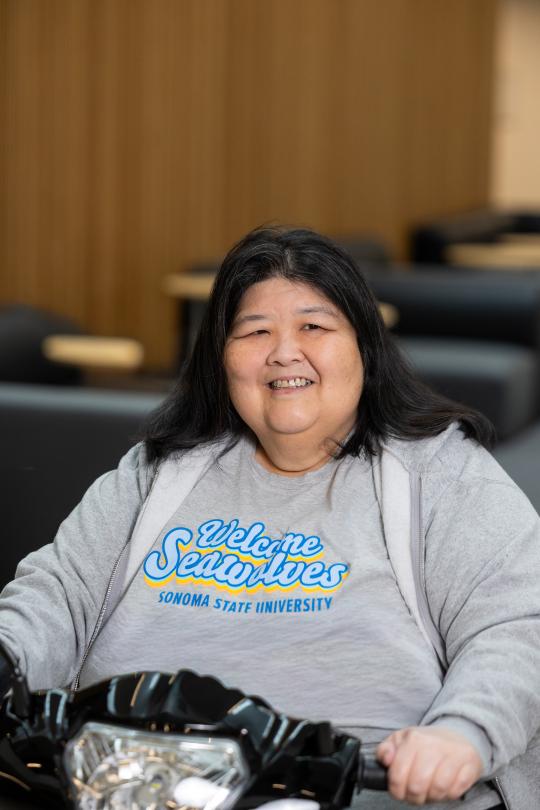
Pronouns:
Any
Tile and Department:
Professor & Department Chair
Kinesiology
How did you end up going into your current role or field and what do you enjoy most about the work you do?
Total accident. I didn’t grow up dreaming of being “Professor So-and-So.” I bounced around—managed a Togo’s, ran front of the house (operations) for theater and rock shows, worked security—before I accidentally fell into graduate school. Getting to research what I want and teach movement classes just felt right. Kinesiology is the perfect mix of what I love: human movement, meaning, and the blend of social and biological sciences.
What do you enjoy most about being part of the Sonoma State community?
The students. Always the students. Kinesiology folks have this energy—curious, hands-on, ready to hustle. They show up wanting to understand how the body moves and gradually learn why it matters. For someone with a mobility disability, teaching about movement hits differently. Watching students connect science, empathy, and purpose? That’s the best part of my job. I’m also blessed with incredible departmental colleagues (and a few honorary Kinesiology members we’ve adopted along the way). We come together to serve students, strengthen our department, and make SSU a campus where people want to be. On a personal note, I have a network here that genuinely cares: people who roll me around in my wheelchair so I can do my job, who bring me dinner when I’m working late, and who appreciate my snark and sarcasm.
What do you find most fulfilling about working in higher education?
Seeing growth. Watching a student who barely engaged in class discover they love working with children with disabilities—or the one who doubted they could ever coach, but ends up confidently teaching a cheerleading stunt — is beyond satisfying. Seeing students who’ve battled imposter syndrome transform into scholars, teachers, and future health professionals? That’s why I’m here.
In what ways does your work make an impact on students, the campus or the broader campus community?
I try to get folks thinking differently about bodies, ability, and belonging. Whether it’s in a kinesiology lecture, a Diversity, Equity, and Inclusion (DEI) presentation, or an Academic Senate meeting, I push for inclusion to be more than a buzzword. Because I had to fight for my own place in this field, my work focuses on creating spaces where people don’t have to fight to belong.